Trimming is the single most cost-effective thing you can do for a tree. Done properly and on a sensible cycle, it keeps limbs off your roof and out of the service drop, sheds weight before winter loads it with ice, and catches small structural problems while they are still small. Done badly — or not at all — it is how healthy trees turn into removals.
Arbor Ridge Tree Service provides Tree Trimming & Pruning for residential and commercial properties across Buffalo and Erie County, with a free on-site assessment and a written quote before any cuts are made.
The Pruning We Actually Do
“Trimming” covers several different jobs. Which one your tree needs depends on its age, species, and what is around it.
- Deadwooding. Removing dead, dying, and broken limbs. This is the highest-value pruning there is, because dead limbs are what actually fall on people, cars, and roofs.
- Crown cleaning and thinning. Taking out crossing, rubbing, and crowded branches so the canopy moves air instead of catching wind like a sail. Selective and light — over-thinning does more harm than good.
- Clearance pruning. Getting limbs off the roof, out of the gutters, clear of the driveway and walkways, and away from the service line to your house.
- Structural pruning on young trees. The cheapest work we do and the most valuable long term. Establishing one dominant leader early prevents the co-dominant stems and included bark that split trees apart twenty years later.
- End-weight reduction. Shortening long, heavy, over-extended limbs back to proper points so they stop levering against the trunk.
If a tree needs its overall height or spread reduced rather than its interior cleaned up, that is a different job — see crown reduction.
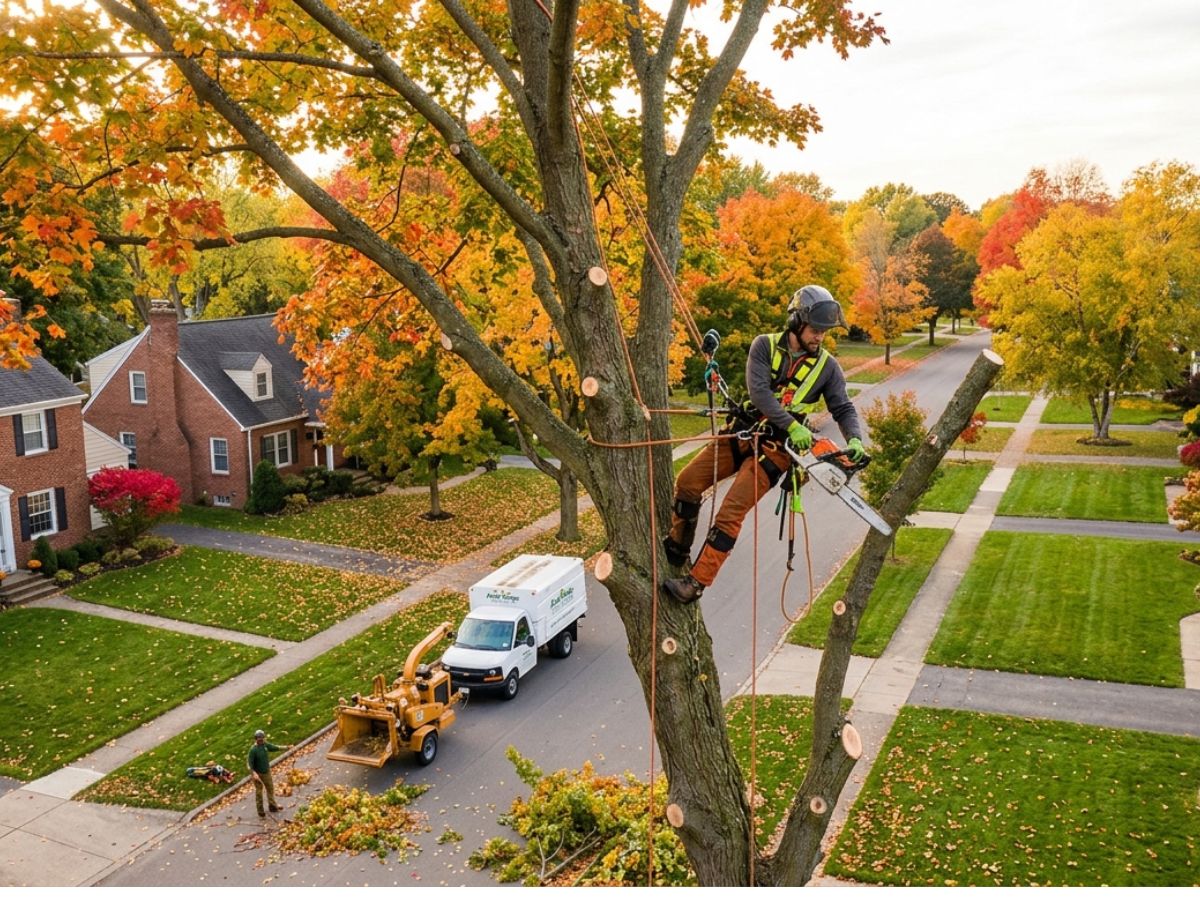
What We Will Not Do: Topping
Topping is cutting a tree back to stubs with no regard for where the cuts land. It is still common, it is cheap, and it is the worst thing you can do to a tree.
A topped tree responds by pushing out dense clusters of fast, weakly attached shoots below each cut. Within a few years it is taller than it was, denser than it was, and every one of those new limbs is anchored badly. Meanwhile the stub wounds cannot seal properly, and decay moves down into the trunk. You end up paying twice: once for the topping, and again for the removal.
We prune to proper points on the tree. If someone has already topped a tree of yours, we can often help it recover through staged restoration pruning — ask us to look at it.
When to Trim in Western New York
- Late fall through winter is the ideal window for most species. The tree is dormant, the structure is fully visible with the leaves off, frozen ground protects your lawn, and disease and insect pressure is at its lowest.
- Before winter specifically matters here. Lake-effect snow and ice add enormous weight to a canopy, and an already over-extended limb is the one that fails in February. Our post on trimming before winter goes deeper.
- Dead, damaged, and hazardous limbs come off whenever you find them. There is no wrong season for removing a hazard.
- Some timing exceptions apply. Oaks are best left alone during the active oak wilt period, and heavy spring pruning on maples and birches causes harmless but messy sap bleeding. We will tell you if your tree is a case where waiting is smarter.
How Often?
For most mature shade trees on Buffalo properties, a cycle of every three to five years keeps things in hand. Young trees benefit from lighter, more frequent structural work. Trees directly over a house, a driveway, or a play area are worth looking at more often simply because the consequence of a failure is higher.
Frequently Asked Questions
Will trimming hurt my tree?
Correct pruning does not. Every cut is a wound, though, so the goal is to make as few as will accomplish the objective, in the right places. Removing too much live canopy at once genuinely stresses a tree, which is why we do not strip trees out for the sake of appearance.
Can you trim limbs near the power lines?
We handle clearance work around the service drop running to your house. The primary high-voltage distribution lines along the street are the utility’s responsibility, and we will point you to them rather than take that on.
Do you clean up?
Always, and it is included. Brush is chipped on site and hauled out, and the area is raked before we leave. If you want to keep the chips as mulch, say so and we will pile them where you want them.
Related Reading
How trimming improves tree health and property safety · Why professional tree service includes regular trimming · Why trimming matters year-round in Western New York · Tree health warning signs to watch for