Table of Contents
Buffalo winters don’t ease in gently. One week you’re raking leaves, and the next you’re dealing with a foot of wet lake-effect snow weighing down every branch on your property. Trees that looked perfectly fine in October can fail dramatically in January, and the difference often comes down to whether anyone took a close look before the weather turned.
A pre-winter inspection is one of the most practical things a homeowner can do. Some of it you can handle yourself from the ground, and some of it genuinely calls for a trained arborist Buffalo NY property owners can trust. This guide walks through both.
Why Winter Is Especially Hard on Western New York Trees
Trees here face a combination of stressors that most regions don’t deal with all at once:
- Heavy, wet snow that accumulates fast and adds enormous weight to limbs, particularly during early and late-season storms when leaves may still be present
- Ice accretion, which can coat branches and multiply their effective weight several times over
- High winds off Lake Erie, capable of snapping limbs that were already weakened
- Freeze-thaw cycles that widen small cracks in bark and wood over repeated seasons
- Frozen, saturated soil, which can reduce root anchorage and contribute to uprooting during wind events
Individually, any one of these is manageable for a healthy tree. Stacked together over a single season, they find every existing weakness. That’s why a professional tree service Buffalo NY homeowners rely on will often recommend inspection in the fall rather than waiting for spring cleanup.
What You Can Check Yourself From the Ground
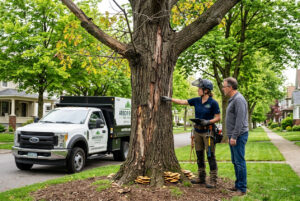
You don’t need specialized training to spot the more obvious warning signs. Walk your property on a clear day and look carefully at each tree, ideally from several angles.
- Dead or hanging branches – Limbs with no leaves during the growing season, or branches already broken and lodged in the canopy, are prime candidates for failure.
- Cracks and splits – Vertical cracks in the trunk or at major branch unions indicate structural compromise.
- Tight, V-shaped branch unions – These are weaker than wide, U-shaped unions and more prone to splitting under load.
- Fungus or mushrooms at the base – Often a sign of root or trunk decay happening out of sight.
- Cavities and hollow areas – Openings in the trunk suggest internal decay may be more extensive than it appears.
- A new or worsening lean – Compare against photos from previous years if you have them.
- Soil heaving or exposed roots – Cracked or raised soil on one side of the trunk can indicate root movement.
- Proximity to structures and utility lines – Note any limbs overhanging your roof, driveway, or power service.
Take photos as you go. They’re useful reference points for later comparison and helpful if you eventually bring in a professional.
Warning Signs That Warrant a Professional Assessment
Some issues can’t be evaluated accurately from the ground, and misjudging them is genuinely risky. Consider calling an arborist Buffalo NY homeowners recommend if you observe:
- Large dead limbs high in the canopy, well out of reach
- Decay at the base of a tree that’s close to your home
- A significant lean on a mature, large-canopy tree
- Multiple trees showing similar decline, which may indicate a spreading disease or pest issue
- Branches touching or growing into power lines, which should never be addressed by a homeowner
- Storm damage from a previous season that was never properly repaired
- Any tree where you’re simply unsure whether it’s safe
An experienced arborist can assess internal condition, evaluate structural risk, and tell you whether a tree needs pruning, cabling, monitoring, or removal.
What Happens During a Professional Tree Inspection
A thorough assessment goes well beyond a quick glance. When a certified arborist inspects your property, the process typically includes:
- Species identification and context – Different species have different failure patterns and tolerances for snow and ice loading.
- Structural evaluation – Examining branch architecture, unions, trunk integrity, and overall balance.
- Root zone assessment – Checking for decay, disturbance, soil compaction, or signs of root movement.
- Health indicators – Looking at foliage history, growth patterns, and signs of pest or disease pressure.
- Target assessment – Identifying what would be affected if the tree or a major limb failed: your house, garage, driveway, neighbor’s property, or utility lines.
- Written recommendations – A clear explanation of what needs attention now, what can wait, and what should simply be monitored.
That last point matters. A trustworthy tree service Buffalo NY provider will tell you when a tree is fine and doesn’t need work, not just quote you for everything on the property.
Pre-Winter Work That Actually Reduces Risk
Once an inspection identifies issues, a few targeted interventions make a real difference before the first major storm:
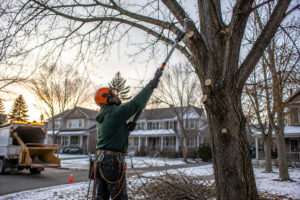
- Deadwood removal – Taking out dead and dying limbs eliminates the branches most likely to fail under snow load.
- Selective thinning – Reducing canopy density allows wind to pass through more easily rather than pushing against a solid mass.
- Weight reduction on overextended limbs – Shortening long, heavy branches reduces leverage during loading events.
- Clearance pruning – Creating space between limbs and your roof, siding, and gutters prevents abrasion damage and ice dam complications.
- Cabling or bracing – Supporting weak branch unions on otherwise healthy, valuable trees.
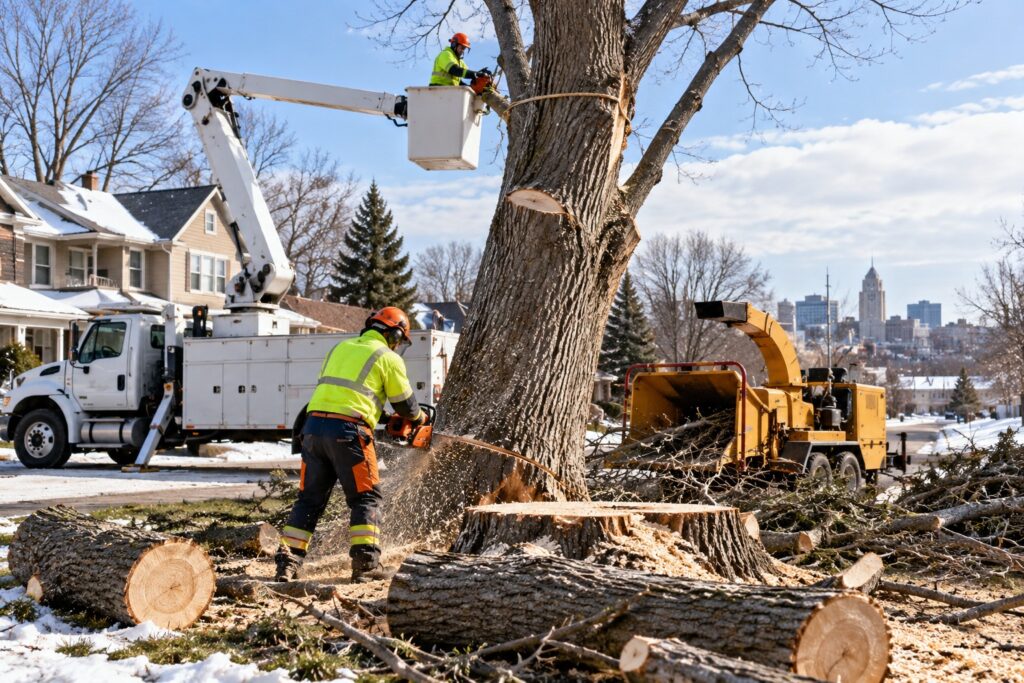
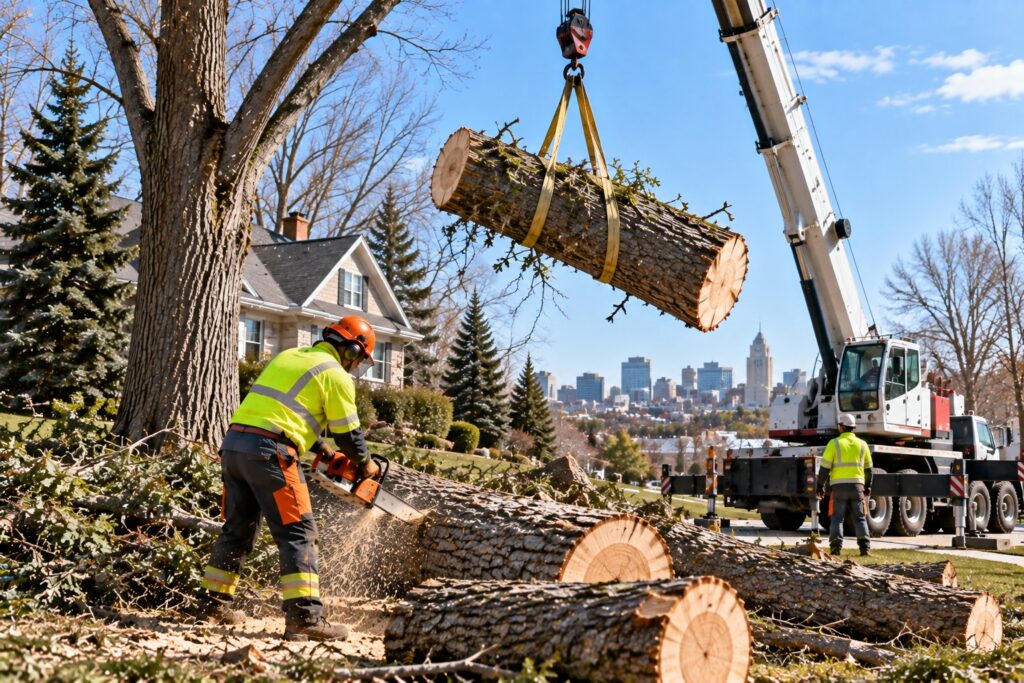
- Removal of hazardous trees – Sometimes tree removal Buffalo NY properties need is the only genuinely safe option, particularly for dead trees near structures.
When Removal Is the Right Call
Nobody wants to lose a mature tree, but occasionally it’s the responsible decision. Removal generally makes sense when:
- The tree is dead, and brittle wood makes failure likely and unpredictable
- Decay has compromised a significant portion of the trunk or root system
- The tree leans toward a home, and root anchorage appears reduced
- Disease is advanced with no realistic path to recovery
- Structural damage can’t be resolved through pruning or support systems
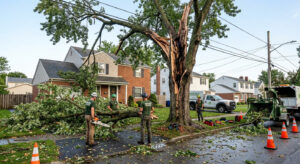
Handling tree removal Buffalo NY homeowners need before winter is generally easier and safer than dealing with it mid-storm, when access is limited and conditions are hazardous. A dead tree scheduled for planned removal in November is a routine job. The same tree down across a driveway in a February ice storm is an emergency.
Building a Seasonal Maintenance Habit
Pre-winter inspection works best as part of a repeating cycle rather than a one-time reaction:
- Fall – Inspect and address structural hazards before storm season
- Winter – Monitor after significant snow or ice events and note any new damage
- Late winter – Take advantage of dormancy for most major structural pruning
- Spring and summer – Watch for pest activity, disease symptoms, and storm damage
Homeowners who build this rhythm tend to spend less over time, because problems get caught while they’re still small.
Frequently Asked Questions
When should I schedule a pre-winter tree inspection?
Early to mid-fall is ideal. It gives you time to complete any recommended work before the first significant snow or ice event.
How often do mature trees need professional inspection?
Every two to three years is reasonable for most healthy trees, though larger trees near structures benefit from more frequent review.
Can I tell if a tree is hollow just by looking at it?
Not reliably. Internal decay often shows few external signs, which is why professional assessment matters for trees close to your home.
Is it safe to prune my own trees before winter?
Small, low branches on young trees are often manageable. Anything requiring a ladder, involving large limbs, or located near utility lines should be left to trained crews.
Does removing dead branches really help during snowstorms?
Yes. Dead limbs are brittle and among the first to break under snow and ice loading, so removing them meaningfully reduces risk.
What if a tree fails during a storm despite an inspection?
No assessment can eliminate risk entirely, since extreme weather is unpredictable. Inspection reduces probability by addressing identifiable weaknesses.
Should I remove a healthy tree just because it’s close to my house?
Usually not. Proximity alone isn’t a reason for removal proper pruning and clearance work often resolve the concern while preserving the tree.
Schedule Your Inspection Before the Snow Arrives
Winter will do what winter does. The question is whether your trees are ready for it. If you’d like a straightforward, honest assessment of what’s on your property, Arbor Ridge Tree Service is here to help with everything from routine pruning to tree removal Buffalo NY homeowners occasionally need.
Contact us today to schedule a pre-winter inspection with an experienced arborist Buffalo NY residents trust, and head into storm season with fewer unknowns.